
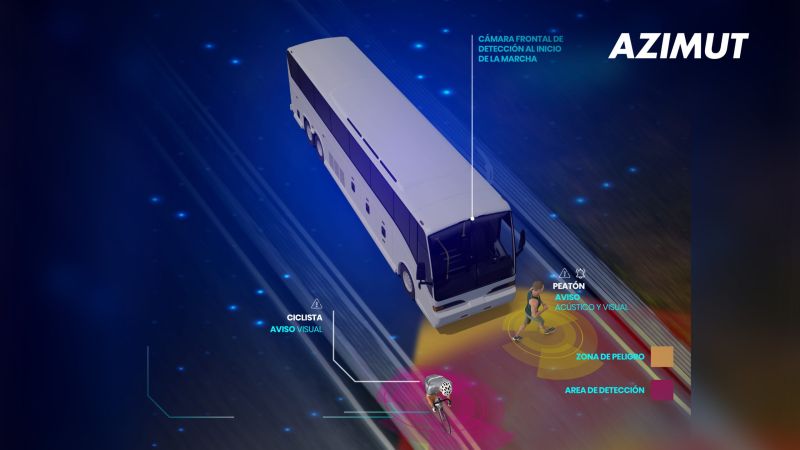
The rules of the game in urban mobility have changed. What was once a trend has now become a mandatory requirement.
If you work in fleet management, procurement, or bus manufacturing and bodywork, you’ve probably already noticed: technical specifications and requirements are increasingly referencing three key standards: R158, R151 (BSIS), and R159 (MOIS). Once these standards appear in these documents, they are no longer optional. They become systems that must be defined, integrated, justified, and maintained.
What is the GSR II, and why is it setting the standard for buses?
GSR II (Regulation (EU) 2019/2144) is the European safety framework that promotes the integration of advanced driver-assistance systems in new vehicles. Its main objective is to reduce risks, with a particular focus on the most vulnerable road users in urban areas: pedestrians and cyclists.
When a regulatory framework like this is translated into specific requirements, the debate shifts from “whether it’s a good idea” to “how are you going to comply?”
The key references that make all the difference
These are the three most common specifications for buses and their practical implications for operators and bodybuilders/OEMs:
R158 – Reversing: Safety Behind the Bus
What it regulates: provisions regarding reversing maneuvers to improve obstacle detection and the driver’s awareness of what is happening behind the vehicle, especially near vulnerable road users.
For operators:
- Maneuvers in garages and berths.
- Stations with limited space.
- Environments with limited visibility where even a small mistake can lead to an incident.
For body shops/OEMs:
- Device integration and location detection.
- Logic and format of driver alerts.
- Documents required for deliveries, audits, and validations.
R151 – BSIS: Side Blind Spot with a Focus on Bicycles
What it regulates: the Blind Spot Information System (BSIS), which alerts the driver to potential collisions with bicycles on the side closest to the vehicle.
For operators:
- Turning and maneuvering in urban areas.
- Approaching stops.
- Coexistence of bike lanes and mixed traffic.
For body shops/OEMs:
- Effective coverage on the near side.
- Consistent assembly across models.
- Compliance across all configurations and variants, avoiding project complications.
R159 – MOIS: Safety When Starting to Drive
What it regulates: the Moving Off Information System (MOIS), which detects pedestrians and cyclists in front of the vehicle when starting off or driving at low speeds; applicable to vehicle categories such as M2/M3.
For operators:
- Frequent starts and stops.
- Intersections and urban environments with high levels of traffic.
- "Stop-and-go" situations where the risk is concentrated in the first move.
For body shops/OEMs:
- Front-end integration and sensor placement.
- Consistency of solutions across variants to avoid constant redesigns.
- Validation and traceability of the implemented solution.
The key to compliance: it's not just about implementation—it's about meeting the requirement
It’s not enough to simply install the systems. These standards require demonstrable compliance with specifications, sustainable operation, and consistent production. In short: compliance + integration + documentation.
How to tackle it in 3 steps
- Review the bid documents and specifications: determine whether R158, R151 (BSIS), and/or R159 (MOIS) are already required. If so, they are no longer optional.
- Putting it into context: a city bus with bike lanes and frequent stops is not the same as an intercity bus. The type of service, the environment, and risk priorities determine the configuration.
- Define the configuration and plan: which systems to use, where to integrate them, how to validate, document, and maintain them. You’ll avoid costly “last-minute fixes.”