

The Advanced Driver Assistance System (ADAS) plus the Blind Spot Detection System (BSD) is responsible for monitoring the road ahead and its surroundings in a comprehensive and proactive manner.
It gives the driver full control of the situation:
- The system generates an event when:
- Pedestrian, bicyclist or scooter interferes with the safety zone.
- An unintentional lane change occurs.
- The braking distance is insufficient with respect to other vehicles.
- The image of the hazardous situation is displayed in high resolution on the driver's display.
- The display warns the driver in English to indicate the dangerous situation.
- All events and dangerous situations can be recorded (configurable function).
How does it work?
The system works through a camera, which is responsible for monitoring traffic conditions and other elements outside the traffic and parameterized as potentially dangerous. Its sensors capture the entire environment and send the information to an intelligent control unit, which calculates the risks and sends warnings and signals to the driver's monitor.
The system, through the front camera and AI algorithm, continuously detects and measures:
- Pedestrians, cyclists or scooters in front of the vehicle.
- Road markings, continuous or discontinuous.
- The distance from the vehicle itself to other vehicles in front of it.
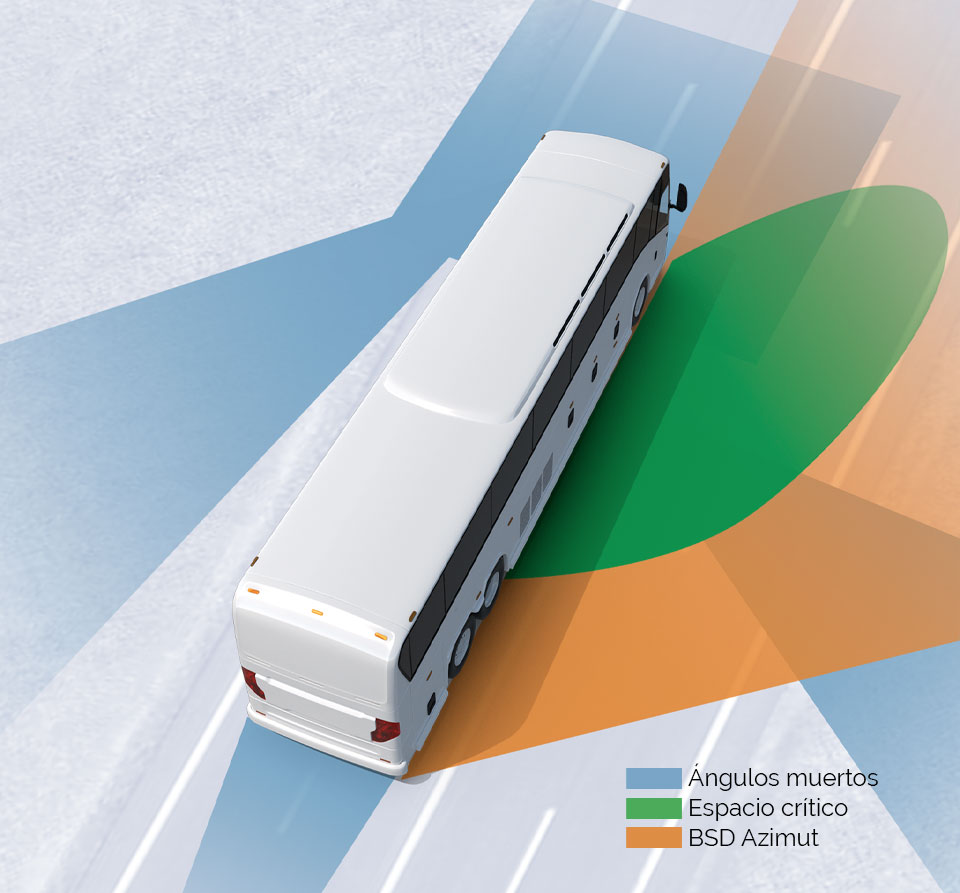
The cameras
These cameras are highly sensitive and incorporate infrared, so they work both at night and during the day without any problems. In addition, they are able to work effectively in the worst visibility conditions, detecting and measuring aspects that would go unnoticed by the human eye.
The switchboard
The processing center is located on the bus itself, and is capable of analyzing information in milliseconds thanks to its powerful processors and an optimized artificial intelligence algorithm. It is also equipped with deep learning or automatic self-learning technology, which enables it to improve its accuracy through continuous experience.
Notices
The monitoring panel located on the driver's dashboard reflects situations clearly and visibly, all with audible alarms in English that allow the driver to clearly identify the level of risk.
The system also has an external loudspeaker, which emits an alert to warn the pedestrian, cyclist or scooter of the dangerous situation and allows them to react accordingly.
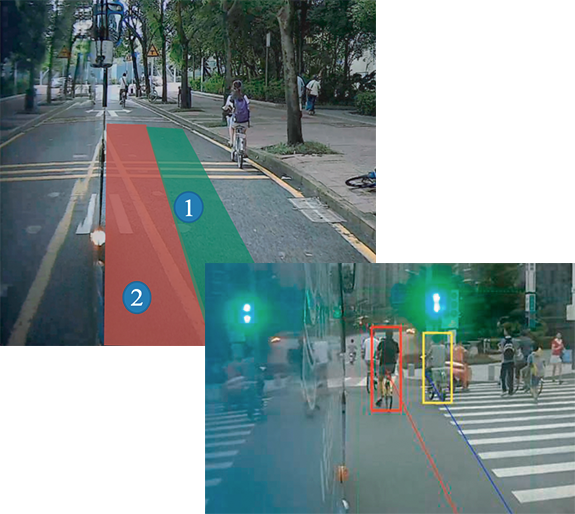
What does it control?
Nothing important escapes the eyes of Azimut's advanced driver assistance system. Pay attention.
- It is able to identify pedestrians in the path of buses and assess the risk of being run over, also avoiding uncontrolled reactions of your drivers.
- It detects marked lines on the road, and reports unintentional lane changes.
- It monitors the distance to other vehicles and assesses collision possibilities and risks.
- Insufficient braking distance alert.
Why should you incorporate it into your fleet?
Far from relaxing the attention of your drivers, the Azimut system keeps them alert and allows them to focus their attention on other aspects of driving that are of vital importance. It makes it possible, in turn, to have information that they would otherwise lack. It is obvious, for example, that your driver knows the safety distance he needs to brake without colliding with the vehicle in front of him, but it is also certain that he cannot know the exact distance at any given moment, let alone instantly calculate the required distance based on his speed. The ADAS systemsystem, in short, facilitates the work of your drivers, making their activity more restful and reducing fatigue and stress. Especially in adverse conditions.